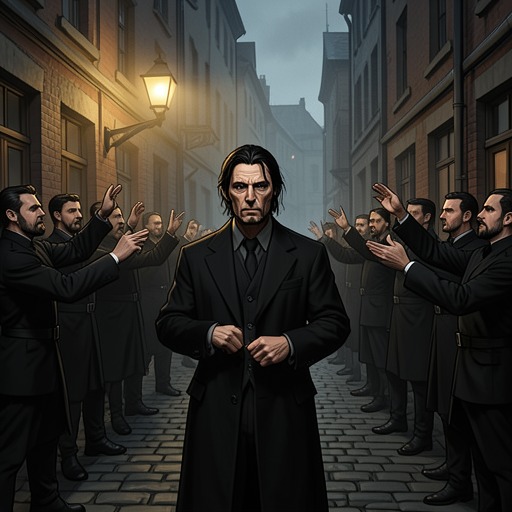
Sexton
Much Ado About NothingSexton is the church official who presides over the examination of Borachio and Conrade after the Watch arrests them. Though he has no aristocratic rank and is not part of the household drama, his questions and procedural judgment become the hinge on which the plot turns: he recognizes the significance of the Watch’s report, carries it to Leonato, and helps transform overheard confession into publicly usable evidence.
Identity and Introduction
Sexton appears in the prison scene as part of a formal-looking inquiry. He enters with Dogberry, Verges, Dogberry’s Watch, Borachio, and Conrade, while the officers are dressed in gowns. The setting and costume give the encounter the shape of an official proceeding, but the proceedings are immediately endangered by Dogberry’s incompetence and verbal confusion. Sexton therefore occupies a distinctive position: he belongs to the same local apparatus as Dogberry, yet he supplies the clarity that the nominal master constable lacks.
His first practical concern is the arrangement of the examination. Verges calls for a stool and a cushion for him, and Sexton asks which people are the malefactors. The details are comic, but they also establish him as the person expected to listen, distinguish the accused from the accusers, and give the inquiry an intelligible order. He is not merely a passive witness to the arrest; the scene places him in the role of an examiner whose attention can determine whether the Watch’s discovery will matter.
The Prison Examination
Sexton repeatedly corrects the direction of Dogberry’s questioning. When Dogberry tries to make sense of Borachio and Conrade’s account, Sexton observes that the constable is not proceeding properly and insists that the Watch, as accusers, must be called forward. Dogberry accepts this as the effective course and orders the Watch to come forth in the prince’s name. The exchange shows Sexton’s authority as procedural rather than social: he does not command through rank or force, but through an understanding of how testimony must be presented.
Once the Watch speaks, Sexton continues to test the report. He asks what else the first Watchman heard after the initial accusation, pressing beyond a vague charge toward the particular content of the overheard conversation. That demand for additional detail is crucial. The Watch has not witnessed a conventional crime directly; it has overheard men discussing deception. Sexton’s questioning makes the difference between an accidental fragment of gossip and evidence capable of explaining the catastrophe at Leonato’s house.
The resulting account is devastatingly specific. The Watch has heard that Don John secretly left that morning; that Hero had been accused and refused in the same manner; and that she had suddenly died from grief. Sexton recognizes that this is more than Dogberry’s officials can deny. He orders Borachio and Conrade to be bound and taken to Leonato’s house, while he goes ahead to inform Leonato of their examination. His action gives the testimony a destination, a responsible recipient, and an immediate consequence: the hidden explanation of Hero’s supposed death will reach the man most damaged by the false accusation.
Truth, Evidence, and Reversal
Sexton’s importance lies in the contrast between the original public judgment and the later recovery of fact. Claudio, Don Pedro, and Don John’s accusation against Hero has been treated as decisive because it appears to possess authority, honor, and male testimony behind it. Hero is questioned about the man supposedly seen at her window, and Don Pedro concludes that because she denies the encounter, she is no maiden. Leonato receives the accusation as a devastating public fact, and Hero swoons as the judgment takes effect. In that earlier scene, the appearance of a legally or ceremonially authenticated claim overwhelms the accused person’s own answer.
The prison scene reverses that structure through a lower-status but better-attentive form of inquiry. Sexton does not produce new visual spectacle; he listens to the Watch’s hearing and asks for the fuller statement that Dogberry nearly mishandles. The crucial knowledge comes from a nocturnal overhearing, then passes through a chain of listeners: the Watch hears Borachio’s confession, Sexton examines the Watch, and Leonato is informed of the record. The scene thus makes procedural attention a corrective to honor’s hasty verdict.
The evidence also identifies the mechanism of the deception. Borachio later confesses that Don John incensed him to slander Hero, that Don Pedro and Claudio were brought into the orchard, and that they saw him court Margaret in Hero’s garments. The apparent proof of Hero’s unchastity was therefore manufactured through disguise and staged observation. Sexton’s earlier decision to preserve and transmit the Watch’s testimony makes that explanation available before the wedding plot can remain governed by the false scene at the window.
Relations and Dramatic Function
Sexton’s relationships are defined less by intimacy than by institutional mediation. He works alongside Dogberry and Verges, but his competence throws Dogberry’s comic inadequacy into relief. Dogberry can order accusations and later asks that people remember he is an ass; Sexton, by contrast, identifies what the examination must contain and understands that the Watch’s report has consequences beyond the prison. Their partnership therefore separates title from usefulness: the constable holds the office, while the Sexton makes the office’s information intelligible.
He also becomes an indirect ally of Leonato and Hero. He does not know Hero through the romantic or familial bonds that govern the other characters, yet his decision to go before the prisoners and show Leonato their examination helps restore the possibility that Hero’s disgrace was false. When he returns with Leonato and Antonio, Dogberry announces that the Sexton has reformed Signior Leonato of the matter. That entrance marks the transition from private grief to informed recognition: Leonato is no longer left to interpret Hero’s apparent death without the evidence of the conspiracy.
The Sexton’s role further links the church setting with the play’s unstable marriage and honor rituals. The surrounding action moves between accusation, binding, confession, mourning, and renewed marriage. His examination does not itself pronounce a final moral sentence, but it supplies the factual basis from which the community can revise its earlier judgment. In a drama where ceremonies and public declarations repeatedly misread what they claim to establish, his modest act of verification becomes unusually powerful.
Change and Narrative Significance
Sexton undergoes no personal transformation in the surviving evidence; his significance is functional and ethical rather than biographical. He begins as a participant in a formal examination and becomes the custodian of a truth that more powerful men have failed to discover. His questions give shape to the Watch’s fragmentary perception, and his movement from the prison to Leonato’s house carries the plot’s corrective knowledge across social levels.
His final importance is measured by the consequences of that transfer. The prisoners are bound and brought to Leonato’s, the conspiracy is exposed, and Borachio’s confession confirms that Hero’s disgrace resulted from deliberate manipulation rather than observed reality. The Sexton thus stands at the point where accidental surveillance becomes accountable testimony. He is comic in the scene’s larger machinery, but the comedy does not cancel the seriousness of his function: when reputation has been destroyed by a false spectacle, truth is recovered because an ordinary official knows how to ask what was actually heard and to whom it must be reported.